Translate

Friday, 5 October 2018

Sometimes you have to change plans.


On Sunday 23rd Sept I had a reunion to go to in Norfolk, which is a 4½ hour drive each way from home. Or 1 hour 20 minutes in the aircraft.

Having checked that I could fly into Cromer airfield and get a couple of taxis and trains to the reunion I decided that I would either fly or not go.

The weather forecasts in the weeks preceding were as expected of 10-15 day forecasts, unreliable and changed to the opposites each day that I checked them. With a few days to go it looked like the remnants of one of the American storms would be sitting in the middle of the country, calling Cromer the day before they were suggesting that in the afternoon of the 23rd there would be strong winds gusting up to 45 knots.

On the morning of the 23rd I headed to the airfield early under a lifting stratus cloud layer, arriving at Tatenhill however there was a lower cloud base and rain. I opened the hanger doors and gave the aircraft a thorough check. Checking the weather showed that the rain would move off to the south and clear the whole route by around 11, and looking out the window this was matched with clearer weather to the northwest.

After a coffee and a breakfast the weather at Tatenhill cleared and improved dramatically. I pulled the aircraft out of the hanger checked my final preparation for the flight.

The weather continued to improve into a good clear sky. So I taxied out and took off, heading south east initially to avoid the East Midlands zone before turning east. The journey east was relaxing with good visibility and receiving a basic service off East Midlands it appeared that there was little other traffic around. I ended the service with East Midlands as the route was passing through the overhead of Fenland airfield.
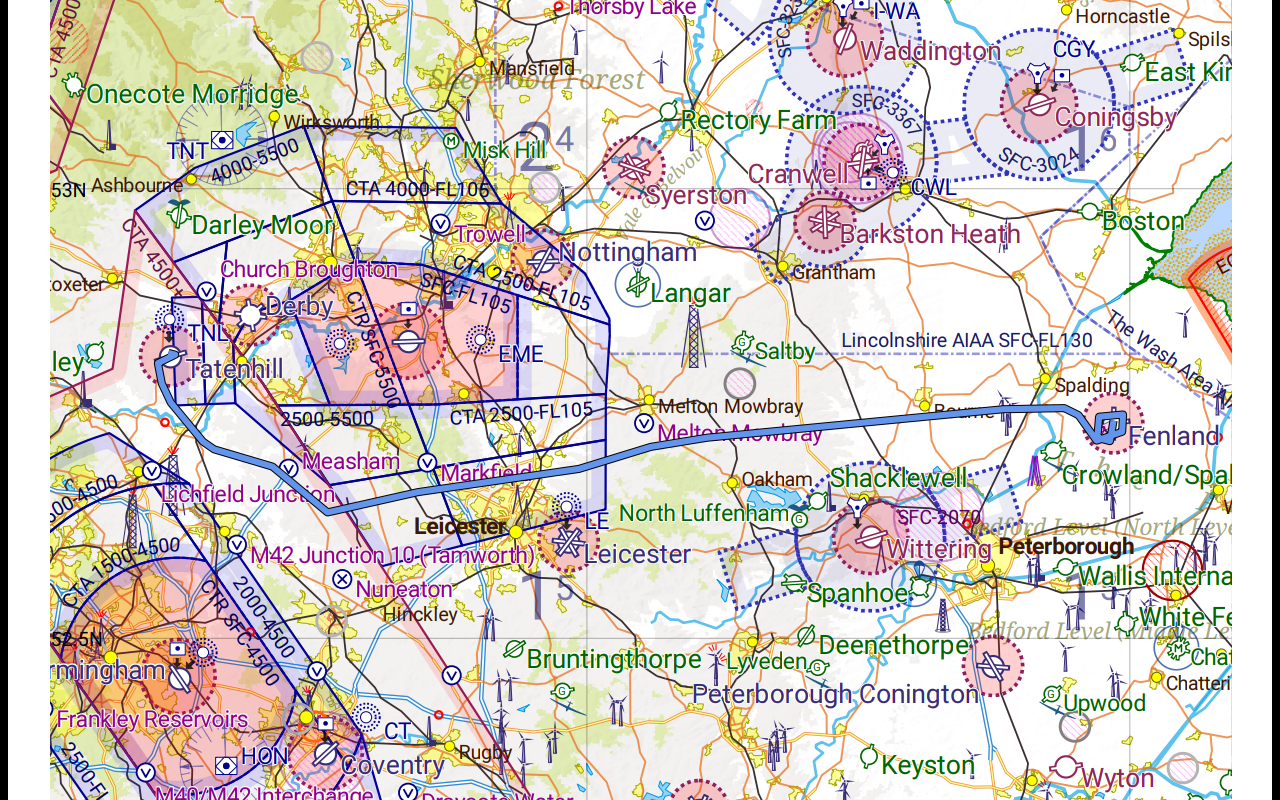


Contacting Fenland to let them know I was passing through their overhead I requested if they were available for a fuel stop, which they said was OK, and that there was currently no traffic in their circuit, so I joined and landed to check out Fenland and pick up some fuel.

Fortunately one of the locals helped me get used to the self service fuel pumps and I topped up my tanks and recorded the landing and intended departure in the airfield logbook. After updating the paperwork in the aircraft I started up and headed off again towards Cromer.

Just after Kings Lynn the cloud base dropped dramatically to 1500 feet so I descended to take a look at the conditions below the clouds. Spotting that the clouds were clearer towards the coast I turned around and climbed up to 2500 to go over the restricted areas of Sandringham and Anmer Hill, before trying my luck along the coast. It wasn’t long before I was back down to 1500 and shortly after that I was faced with a wide band of showers, having a look at the showers they were quite heavy and I realised that I would have limited visibility and would be close to Instrument Conditions (IMC) which I am not currently licensed to fly in. I did not fancy arriving at a short grass airfield that I had never been to before, low and in limited visibility. Looking north the showers appeared to extend a few miles out to sea, I thought that they would be around for some time, so I made the decision to turn around and head for home.
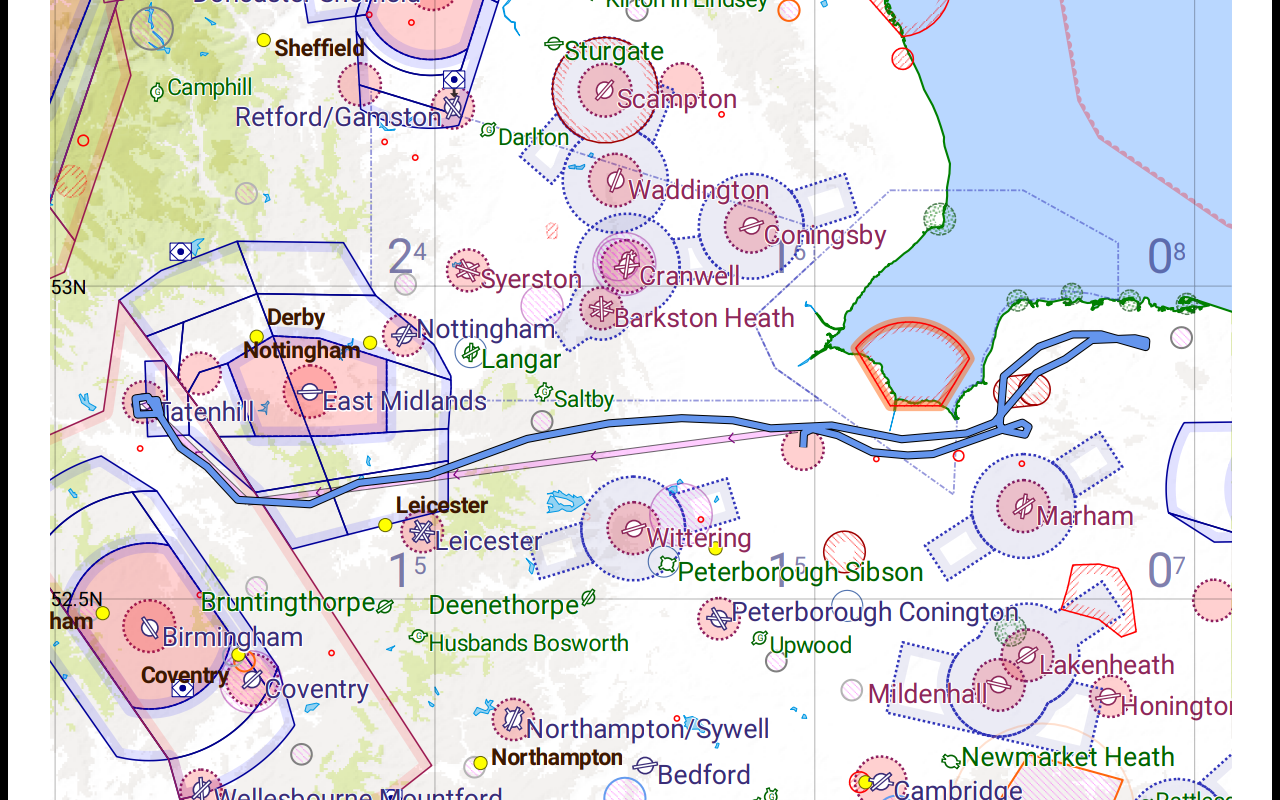


The return journey was great and the weather over the centre of the country remained excellent throughout the rest of the day. Although I was only on a basic service with East Midlands the controller warned me of other traffic just before I changed frequency back to Tatenhill.

Although I did not make it to the reunion, it was an interesting trip and I managed to get into a different airfield and get experience on a shorter, grass airfield and learn of a great location to pick up fuel/ break if I am out to the east.

Friday, 17 August 2018

Return from Beverley via Spurn Point

The return leg of our flight up to Beverley was folloing  more scenic route down the coast to Spurn Point before turning inland at Grimsby, as this was a weekend and the weather was good we transited over RAF Waddington at 4500ft.  One of the reasons for coming north on this trip and not south was because the weather was good and there were a number of gliding competitions to the south to avoid (as one pilot found out).

After a little time and booking out at Beverley I checked the Cessna over and manually checked the fuel tanks to see how much was left in. Happy with the aircraft we climbed in and prepared to the return journey. After the last checks just short of Beverley's Alpha old, we lined up rolled down the grass of runway 12 and in a short time were airborne, turning left we headed out of the circuit to the north until clear and set course east for the coast, before following the coast southbound, and contacting Humberside radar for a basic service.

Offshore windfarm
Looking out to sea, I pointed out that the sight of the offshore wind farm was a bit of a surreal sight. A huge area of white stalks sticking up out of the sea, as we were moving it reminded me slightly of the graphics from old computer games.

Spurn Point
As we approached the Humber Estuary I turned inland to avoid the Gas Venting station that was marked on the map, such that we passed slightly inland of Spurn point. The Humber estuary is quite a substantial body of water and it feels odd flying over it for someone who is used to normally flying overland, at least this takes some of the edge off When I decide to head to the continent at some point.

Leaving Spurn Point behind we passed to the east of Grimsby and started the turn inland towards Bardney disused airfield.

Climbing up to 4500ft, we travelled through quite smooth air up until our next turn at Bardney disused airfield.

Having confirmed with Humberside that Waddington Zone was not active the controller politely reminded me that at my altitude we could go straight over the top as long as I stayed out of their ATZ.

After shortly after passing over Waddington the controller said that I was passing outside his cover and that I should free-call East Midlands for a service off them.  I tuned into East Midlands and listened for a gap in the comms.  G-OM had just called them requesting for a 'traffic service', this is a service from a radar controller that gives information and warnings of other traffic that may affect the flight.  As soon as the controller had identified G-OM he gave him a warning of 'two contacts straight ahead 1 mile, no height' which G-OM replied, 'seen, gliders taking avoiding action'.  There then followed a couple of minutes of radio exchange between the two of them as the pilot weaved his way out from the middle of a large group of gliders with the assistance of East Midlands.

Once the airwaves settled down, both me and another aircraft contacted East Midlands to request services from them.

The rest of the flight went well, and as the route approached Tatenhill and the controlled airspace surrounding East Midlands lowered, I descended a couple of  times to keep clear. Passing over the recently disused Hucknall airfield, which is rapidly becoming a housing estate.

Arriving back at Tatenhill at 1645 I was happy to see that fuel was still available and topped up the aircraft so that the next pilot didn't have to.  Taxiing back to the hanger, cleaned the bugs off and put the aircraft to bed until its next adventure.

All in all a successful trip as we got to see a new airfield, had a nice view of the coast and some different sights. Additionally I have gained more confidence talking to air traffic and using the radio equipment in the aircraft. I look forward in the near future to either doing a transit of controlled airspace, or utilising a traffic service.

Flight Details:
Distance: 127nm
Duration: 1h 27m
Sights: Spurn Point, Humber Estuary

Tuesday, 14 August 2018

Early August flight to Beverley airfield

Just over an hour away from Tatenhill is Beverley airfield, which had a free landing fee voucher in the summer edition of Flyer, although I didn't really feel put upon by the rather reasonable £5 landing fee and didn't take much effort to take the Flyer voucher with me.

The weather was good, with light winds and cloud bases around 4-5000 feet, so I opted to take advantage and fly at a higher altitude than I had flown since renewing my licence.

We decide to head out to the south of Gamston airfield and then head up between Doncaster and Humberside airport at 3500ft, the return journey was more of a coastal route.

Arriving at the hanger I was greeted with the new hanger doors which had been installed since I was last flying these took a few seconds to work out how to open them.

With the preflight checks complete, we strapped in and headed for the runway. Following a smooth takeoff we turned right to head north, being careful to stay clear of Darley Moor hang gliding site, which was a good thing as looking over n their direction we watched one of the hang gliders completing a winch launch. Shortly after passing Darley moor we took up the Easterly track to Carsington Water and on to the next way point of Ossington Disused airfield.

Contacting East Midlands for a basic service and getting their QNH which lets us setup the altimeter to ensure that we remain below East Midlands airspace. Once clear of East Mids we could then climb up to our planned cruise altitude of 3500ft.

Passing Mansfield, East Midlands requested we change off their frequency and suggested we contact Doncaster, however I decided to head for the rest of the trip north without talking to anyone until we we closer to our destination. This Altitude would provide us with some buffer over the airfields and gliding sites on the next leg, although I did turn off the track to avoid a glider that was gently climbing to the north of Darlton.

The Humber and bridge from 3500ft
Flying further north we could start to make out the humber and Hull beyond, which allowed us to get a good view of the Humber bridge out of the right window. Starting the descent towards Beverley as we passed over the suburbs of Hull.

Setting the radio for Beverley’s radio frequency, Beverley have a new radio frequency that is based on the 8.33Khz separation rather than the older 25Khz frequency. I called up and received the latest information, that they were on Runway 12 passed me their QFE, shortly after one of the arrivals (a Europa) announced that they had dead sticked (landed without power) the landing and had stopped at the end of the runway, this would mean that it would be unsafe to land until they had been cleared off. I continued to do an overhead join and enter the circuit, the overhead join unusually at Beverley is at 1500’ and all the circuits are to the north of the field which allowed a left hand circuit onto runway 12.

Beverley clubhouse and hangers.
As we continued to join and fly round the circuit we could see the rescue truck driving out to assist the stranded Europa and assist removing it from the runway, fortunately it was clear of the runway when we turned onto finals. After a nice approach and a short landing we were able to taxi off the runway and follow the Europa back to the parking.  We did not take on fuel at the airfield, although the fuel bowser is conveniently located near the clubhouse with good access from the parking area.


Beverley Clubhouse
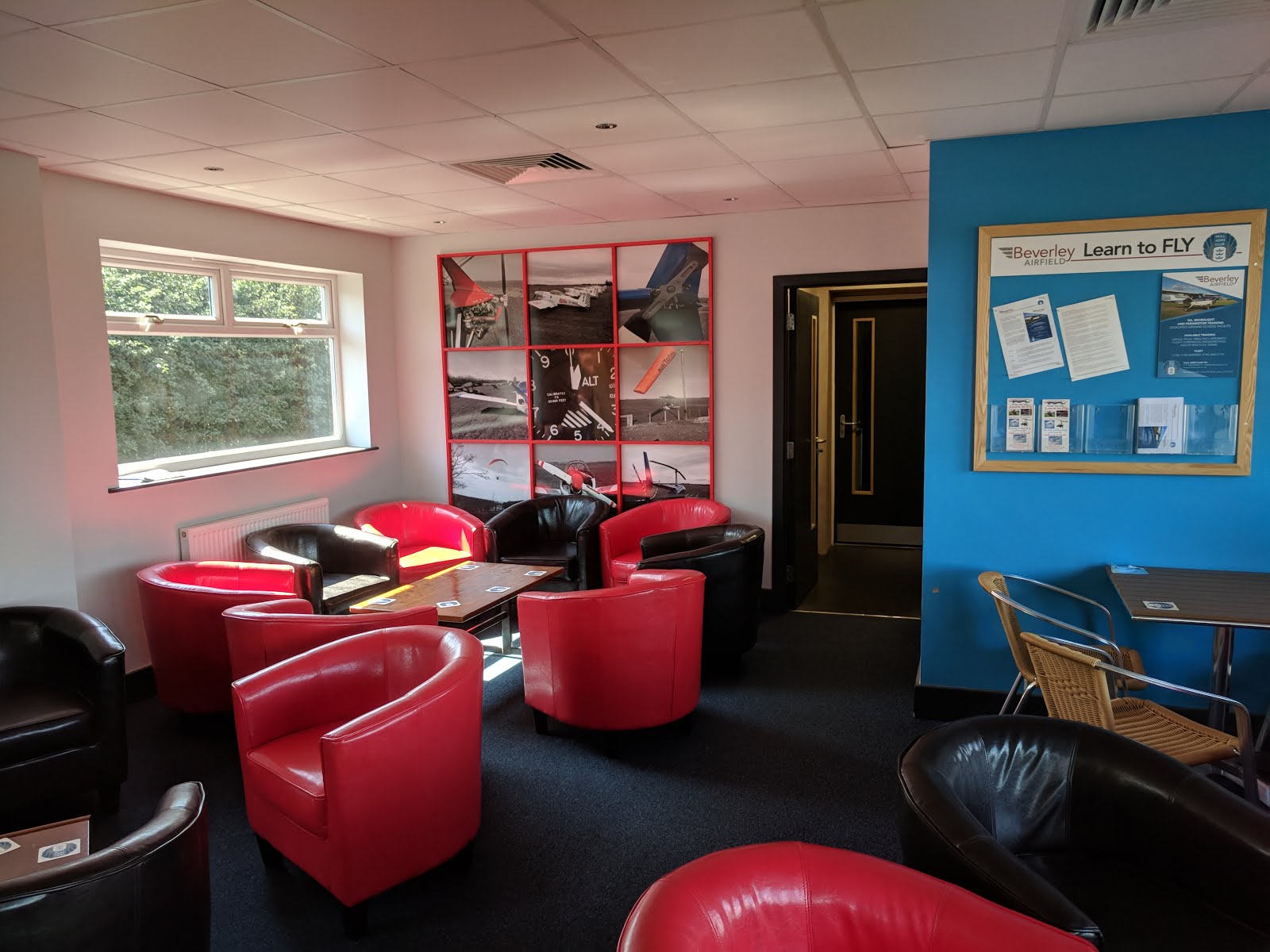
Once parked up we found that Beverley had a nice little well maintained clubhouse with a small cafe where drinks and food could be purchased along with a nice seating area with comfortable chairs, outside were a number of picnic tables that had a good view of the airfield.

Landing fees were a most reasonable £5 which were paid with a short welcoming chat with airfield management in the corner of the clubhouse.


Having spent a short time at Beverley I would recommend it as either a destination in itself or a stopping point on a larger adventure.

Flight details:
Distance: 109nm
Duration: 1h 05m
Landing Fee (Beverley: £5
Sights: Humber and the Humber Bridge


Saturday, 9 December 2017

First land away since PPL renewal

Having done a bit of local flying, including a first flight with passengers I was itching to get out of the local area and head to a different airfield, so set up a plan to fly to Turweston airfield in Oxfordshire.


The weather was looking good for a trip on Friday 1st December, so I booked one of the PA28 Archers the day before, the only issue with the weather would be a cross wind from the north, so it all depended on the strength of the wind.


Arriving at the airfield, I signed the aircraft out, contacted Turweston with the airplane details as they request inbound pilots obtain prior permission and was told they were using runway 27 Right.


A thorough check of the aircraft inline with the PA28 checklist and we were ready to set off.  At Tatenhill the grass on the airfield is waterlogged at the moment so all the planes are parked on the tarmac which makes for a very crowded and complex environment and I had to wait a few minutes for one of the other aircraft to complete its run up and pre takeoff checks.


As Birmingham was on track and heading for the Daventry VOR made a nice kink I was planning to track the radial down to the VOR and turn direct to Turweston when passing Daventry town itself (about 5 miles short of the VOR) and do the reciprocal on the return journey.


Although there was almost a 90 degree crosswind it was fairly light so the take off and turn out of circuit was fairly comfortable.  Although there were few clouds, the base was around 1900ft on the QNH so I stayed below my prefered altitude until around Daventry when they cleared more.


Heading south I set the radio to East Midlands and set up their listening squawk, which was something new to me but something that I think I will use in the future.  Squawking the code for East Midlands allows them and other air traffic units that I am listening on that frequency, so they can give me a call if they need to.


Tracking the Daventry VOR did not go quite as planned on the journey south and I never really got on top of it.


Approaching Turweston I changed the squawk back to 7000 and called them up on the radio, where the joining instructions reiterated runway 27 RH.  Silverstone stood out as a great landmark, but I was late spotting Turweston airfield and put in an orbit north of the airfield to settle myself down and plan the circuit.  Joining downwind and heading down the circuit I heard someone joining for an overhead join.


The circuit at Turweston is odd in that the approach and departures are offset 20 degrees from the runway to avoid houses on the extended centreline, so this was a bit of a new challenge as the last time I had to contend with this was when I was training for my PPL back in the 90s.


My approach went quite well up until I ballooned the flare and so elected to go around and have another go.  Heading back up to circuit height I could see the other aircraft in circuit heading across the upwind of the airfield to start the downwind.  All through the circuit I was aware that it was going to be fairly tight as to whether he would still be on the runway when I arrived to land.  Fortunately he must have had the same problem as I had off the first approach and he also went around for a second attempt leaving the runway clear for me to land.  This attempt was a vast improvement on the first go and is probably one of the best landings since I restarted flying, definitely better than the landing at Tatenhill on the return flight.


Since I was last here there has been a large investment in the airfield and the airfield offices and control have moved out of their previous portacabins and into a nice shiny conference centre/tower complete with cafeteria.  So it was up to the top floor to pay the landing fee and then back down to the first floor for a light lunch and had the chance to bump into some people that I had known when I was flying previously.


The flight back was a lot more relaxed, and I managed to follow the radial back out from Daventry to Tatenhill.


Following us back into Tatenhill we were followed by a student in one of the Cessna 152s as she returned from her qualifying cross country.


After parking the aircraft we tidied up, paid for the flying and headed for home.


This trip allowed me to practice some things that I had not used for so long, and the return leg was much smoother and relaxed as I learned from the issues of the outbound lag and put them into practice for the return.

All in all a successful day’s flying.